


Setting up multiple companies to separate business interests can seem very straight forward. There are however important considerations. We explore the implications of owning too many companies.
June 2025 Newsletter
20 June 2025
Accounting & Compliance, Payroll, People, Reducing Tax
HMRC Spring Tax Update
On 28 April 2025, the Government made several tax policy announcements, launched consultations and confirmed previously announced developments.
Key points included:
Mandatory payrolling of benefits in kind (BIKs) will be delayed until 6 April 2027.
This is to give more time for software providers, employers and tax agents to prepare for the change.
The mandate was previously intended to take effect from 6 April 2026.
From 6 April 2027, mandatory payrolling will apply to most BIKs, except for employment-related loans and accommodation benefits.
These may be payrolled voluntarily from April 2027.
HMRC revised its Check Employment Status for Tax (CEST) digital tool on 30 April 2025, to make it easier to use.
HMRC is committed to standing behind the outcomes of the tool where it has been used correctly, and has published guidance on how to answer the revised questions.
The tool is used by workers to help them determine whether their work on a specific engagement should be classed as employed or self-employed for tax purposes.
If you have multiple employments or are both employed and self-employed, a cap (the ‘annual maxima’) limits the total National Insurance Contributions (NICs) you need to pay.
If you pay more than you need to, you can make a claim for a refund from HMRC at the end of the tax year.
The Government have said that the process for refunding NICs under the annual maximum rules will be reviewed to make it easier and faster for taxpayers to access refunds.
The VAT Capital Goods Scheme (CGS)
This is a mandatory scheme that ensures the VAT reclaimed on certain capital assets reflects the extent to which the asset is used for taxable business purposes over a prescribed time period.
The Government has announced proposals to remove computers from the list of capital assets within the scheme and to increase the VAT-exclusive value of land and buildings that are caught by the scheme from £250,000 to £600,000.
No date for these changes has been announced.
A consultation has been published on the VAT treatment of business donations of goods to charity.
Views are sought on a new VAT relief aligning the treatment of goods donated for distribution to those in need or use by the charity with the existing relief for goods donated for onward sale.
It’s P11D Season!
P11D forms for reporting expenses and benefits in kind provided to employees and directors in 2024/25 need to be submitted by 6 July 2025.
Note that paper forms are no longer acceptable; the return must be made online using PAYE Online for employers or commercial software.
Remember that reimbursed expenses no longer need to be reported where they are incurred wholly, exclusively and necessarily in the performance of the employee’s duties.
Dispensations from reporting are no longer required, although HMRC would expect internal controls to be in place to ensure that the expenses qualify.
Note also that trivial benefits provided to employees that do not exceed £50 do not need to be reported.
This typically covers non-cash gifts to employees at Christmas and on their birthdays, and can include gifts of food and alcohol.
Again, the employer needs to keep a record of the benefit provided and the justification.
It should not be provided as a reward for past or future service.
Our team have been working their way through completing P11Ds, so you should have already been contacted by a member of the team if this applies to you.
If you believe you may need to complete a P11D for providing company benefits (such as medical insurance, company cars) and haven’t yet been contacted, then please get in touch with your account manager.
Official Rate Of Interest
For employers reporting beneficial loans and some employment related living accommodation on form P11D for 2024/25, the official rate of interest (ORI) to be used is 2.25%.
The charge applies where the amount of the loan exceeds £10,000.
The ORI increased to 3.75% on 6 April 2025.
From 2025/26 onwards, the rate will be reviewed on a quarterly basis with any changes in the rate occurring following a quarterly review, where appropriate.
If there are any in-year changes to the rate, these will take effect on 6 July, 6 October and 6 January.
Double-Cab Pickups – Rule Changes For Benefit In Kind Purposes
Following a recent Court of Appeal ruling, from 6 April 2025, the classification of double-cab pickups (DCPUs) will need to be determined by assessing the vehicle as a whole at the point that it is made available to determine whether the vehicle construction has a primary suitability.
If the vehicle is primarily suited to carrying goods or burden, for direct tax purposes it can be treated as a van.
Most DCPUs are suited to both passenger transport and carrying goods, so they do not have a primary suitability.
It therefore follows that most DCPUs are expected to be classified as cars when calculating the benefit in kind charge.
Transitional arrangements apply for employers that have purchased, leased, or ordered a double cab pickup before 6 April 2025, whereby they will be able to rely upon the previous treatment until the earlier of:
· disposal,
· lease expiry, or
· 5 April 2029.
2024/25 Employment-Related Securities Returns Due By 6 July
The deadline for reporting shares and securities and share options issued to employees for 2024/25 is 6 July 2025.
This is the same as the deadline for reporting expenses and benefits provided to employees on form P11D for 2024/25.
Employers must submit their employment-related securities annual returns online and attach the appropriate spreadsheet template if they have something to report. HMRC provide templates on their website that may be downloaded in order that the information may be entered and uploaded.
Note that there are different templates for each of the four tax-advantaged employee share schemes – Company Share Option Plan (CSOP), Enterprise Management Incentives (EMI), Save As You Earn (SAYE) share options and Share Incentive Plans (SIP).
In addition, employers need to report any other employment-related securities (non-tax-advantaged) issued to employees and directors.
We can of course assist you with the completion of the reporting obligations and with the valuation of the securities concerned.
For all our clients we have reviewed whether a return is required and been in contact if necessary, however if you have any queries or concerns then please contact your account manager.
VAT Groups And Anti-Avoidance
HMRC have published Tax Avoidance Spotlight 70 ‘VAT grouping structure arrangements used by care providers’, highlighting tax avoidance arrangements used by state-regulated care providers to reclaim VAT.
The VAT legislation exempts supplies of welfare services where they are made by either a charity or a state-regulated care provider.
The impact for the charity or state-regulated care provider is that they are unable to recover any VAT which relates to these supplies.
The arrangement identified in Spotlight 70 is intended to work as follows:
· An unregulated entity forms a VAT group with the state-regulated care provider, or charity.
· Existing contracts for welfare services between the regulated body and the local authority or NHS are transferred to the unregulated provider. New contracts are drawn up with the unregulated care provider.
· The unregulated care provider then sub-contracts the physical provision of welfare services back to the regulated care provider. A facilitation measure in the VAT grouping legislation means that where services are supplied between members of the same VAT group, they are disregarded for VAT purposes.
· As the supplies of welfare services are being made by an unregulated care provider, they are taxable at the standard rate of VAT.
· The VAT group can reclaim input tax in respect of those taxable supplies. Were it not for this arrangement, the reclaim would be blocked.
HMRC consider these specific VAT grouping arrangements to be a form of tax avoidance.
They say that, where necessary, they will refuse VAT group registration applications that are designed to implement, or facilitate, these avoidance structures.
They are also reviewing existing group arrangements where it is known or suspected that this avoidance arrangement is in operation.
During this review, HMRC may request additional information and will assess each case individually.
If Spotlight 70 affects you, please talk to us – we are here to help.
Advisory Fuel Rates
The table below sets out the HMRC advisory fuel rates from 1 June 2025.
These are the suggested reimbursement rates for employees’ private mileage using their company car.
Where the employer does not pay for any fuel for the company car these are the amounts that can be reimbursed in respect of business journeys without the amount being taxable on the employee.
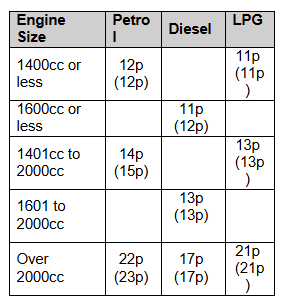
The previous rate is shown in brackets.
You can continue to use the previous rates for up to 1 month from the date the new rates apply.
Note that for hybrid cars you must use the petrol or diesel rate. For fully electric vehicles the rate is 7p (7p) per mile.
Employees using their own cars
For employees using their own cars for business purposes, the Advisory Mileage Allowance Payment (AMAP) tax-free reimbursement rate continues to be 45 pence per mile (plus 5p per passenger) for the first 10,000 business miles, reducing to 25 pence a mile thereafter.
Note that for National Insurance contribution purposes the employer can continue to reimburse at the 45p rate as the 10,000 mile threshold does not apply.
Input VAT
Within the 45p/25p payments, the amounts in the above table represent the fuel element.
The employer is able to reclaim 20/120 of the amount as input VAT provided the claim is supported by a VAT invoice from the filling station.
For a 2500cc petrol-engine car, 3.83 pence per mile can be reclaimed as input VAT (23p x 1/6).
The content in this blog is correct as at 18th June 2025. See terms and conditions.

