


Setting up multiple companies to separate business interests can seem very straight forward. There are however important considerations. We explore the implications of owning too many companies.
January 2024 Newsletter
17 January 2024
Accounting & Compliance, Estate Planning / IHT, Reducing Tax
Time to Review or Make a Will?
At the top of the New Year to do list for many individuals is to make or update their Will.
Many think this is something to leave until later in life, but it is important to get things in place once property is acquired or when children come along.
Dying without a will
In the absence of a will there are statutory rules which dictate how your assets are distributed on death.
Those statutory intestacy rules may not be tax efficient, and you might want to make specific provision in your Will for your unmarried partner or for the guardianship of your children.
People often think that if they die without making a Will, their spouse (or civil partner) will automatically inherit everything, but this is not necessarily the case.
Intestacy Law
According to the laws of intestacy in England, for deaths occurring on or after 26 July 2023, the surviving spouse would inherit a statutory legacy of £322,000, all of the personal effects, and half of the remaining estate.
The deceased’s surviving children (or their descendants) would split the remaining half of the estate equally.
If those descendants are under the age of 18, their inheritance is kept back for them until they turn 18.
Note that intestacy rules are different in Scotland, Wales and Northern Ireland.
Making a will
If you’d like to discuss either making or updating your Will, then please get in contact.
We can recommend a suitable solicitor to draw this up and work with both them and yourself to ensure your Will is as tax efficient as possible.
Passing on the Family Home
When considering the wording of your Will, you should note that the inheritance tax (IHT) nil rate band continues to be frozen at £325,000, subject to any announcements in the Spring Budget.
There is currently an additional nil rate band of up to £175,000 for passing on the family home to direct descendants on death.
We can work with your solicitor to make sure your Will is tax efficient.
Nil rate bands
Where some of the nil bands are unused on the death of the first spouse, the balance is available on the death of the surviving spouse, potentially allowing a married couple (or civil partners) to pass on assets of up to £1 million at today’s rates without paying IHT.
The residence nil band is even available when you downsize to a cheaper property.
For example, if a married couple currently live in a large house worth £500,000 and downsize to a flat worth £300,000, they could give away some of the proceeds during their lifetime and yet still benefit from inheritance tax relief based on the higher valued property.
They could even sell the house and move into a rental property or a care home and still benefit from this nil band.
IHT Planning
Jan Friend is our resident IHT specialist at Friend & Grant – if you’d like to discuss inheritance tax planning to minimise your exposure and ensure the maximum amount is passed to your loved ones, then please get in touch with Jan directly or give us a call on 01634 731390.
With IHT currently at a rate of 40%, there are significant savings to be had with effective and timely advice, so act now!
Pension Contributions on Behalf of Others
Normally an individual’s payments into a pension scheme are limited to their relevant earnings in a given tax year.
However
This restriction does not apply where the contributions are less than £3,600 gross, allowing parents and grandparents to make payments on behalf of children and grandchildren with limited income.
Payments of £2,880 a year would attract a 25% uplift from the government which could grow to a substantial amount by the time the child reaches retirement age (currently age 55, but increasing to 57 in 2028).
The parent or grandparent may be able to justify that the payments qualify for the regular gifts out of income exemption from inheritance tax mentioned above if a standing order was set up for no more than £240 a month.
Company Directors
Similarly, where a company director wishes to make pension contributions, they are usually very limited as dividends do not class as relevant earnings for pension contributions.
In this situation, it is tax efficient for their limited company to make employer pension contributions on their behalf.
This way, the company is not subject to the same ‘relevant earnings’ constraint.
The pension contribution is not taxable income to the director, and it’s entirely tax deductible for the company.
Individual Pension Allowance
It is worth noting however that each individual has a pension allowance of £60,000 per annum – this is the maximum gross contributions they, or an employer, can make into their pension per year.
This allowance may be reduced if an individual earns in excess of £200,000 per year.
If you’re thinking of making additional pension contributions either personally or via your limited company, and would like to discuss pension planning, please get in touch with your account manager.
Update Payroll Software for the January NIC Cut
The Chancellor’s announcement of a 2% cut in national insurance contributions (NICs) for employees applies to payments on or after 6 January 2024.
That doesn’t allow much time to update payroll software, particularly with the Christmas holidays in between.
Note that for employees other than directors, NIC is not calculated on a cumulative basis so, where over-deductions are made, the error is not automatically corrected in later months.
Directors
For the whole of 2023/24, directors on the standard method (this is the cumulative annual method for NI) will be on a blended National Insurance rate of 11.5%.
11.5% is a pro-rata amount as there’s 9 months at 12% and 3 months at 10%.
Fuel Rate Update
There have also been updates to HMRC advisory fuel rates from 1 December 2023.
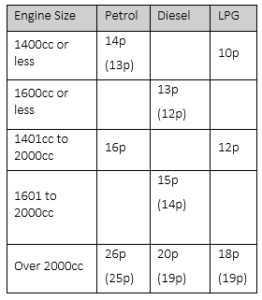
These are the suggested reimbursement rates for employees’ private mileage using their company car.
Where the employer does not pay for any fuel for the company car, these are the amounts that can be reimbursed in respect of business journeys without the amount being taxable on the employee.
Where there has been a change the previous rate is shown in brackets.
You can continue to use the previous rates for up to 1 month from the date the new rates apply – so from 1st January 2024, the rates above must be used.
Note that for hybrid cars you must use the petrol or diesel rate.
For fully electric vehicles the rate is 9p (10p) per mile
Year end Inheritance Tax Planning
Many were expecting an announcement from the Chancellor in the Autumn Statement about cuts to, or the possible abolition of, inheritance tax (IHT).
Maybe he is saving that for his Spring Budget, but in the meantime, it may be worth utilising the £3,000 gifts annual exemption for 2023/24 and, if available, the unused amount from 2022/23.
Note that £3,000 is the overall exemption for the tax year, not the amount for each gift.
Potential Restrictions
One tax planning opportunity that many thought the Chancellor might restrict was the exemption from inheritance tax for regular gifts out of an individual’s surplus income.
Inheritance tax is designed to tax transfers of capital, so if the donor can demonstrate that the gifts are made out of surplus income then the transfers are not taken into consideration for IHT.
Exemptions
The exemption applies where there is a regularity to the payments, such as a standing order to pay school fees or pension contributions on behalf of children or grandchildren.
HMRC will also require proof that the payments are paid out of post-tax income and do not limit the donor’s normal lifestyle.
Detailed records are required, and we can help you with a suitable spreadsheet.
The content in this blog is correct as at 17th January 2024. See terms and conditions.

