


Setting up multiple companies to separate business interests can seem very straight forward. There are however important considerations. We explore the implications of owning too many companies.
March 2026 Client Newsletter
19 March 2026
Accounting & Compliance, Ambitious Startups, Cloud Accounting, Reducing Tax, Structuring a Business
Spring Forecast
During a week dominated by news of the Middle East conflict, on 3 March 2026, Chancellor Rachel Reeves presented the Spring Forecast to Parliament.
The Chancellor told MPs she had “restored economic stability” as she presented the Office for Budget Responsibility’s (OBR’s) economic forecasts.
The Chancellor focused on how the government’s policies are delivering economic growth, particularly when looking at Gross Domestic Product (GDP) per person.
However, the OBR’s report indicates a more nuanced picture and notes that the fiscal context for the next Budget will remain challenging.
As part of the government’s policy of one major fiscal event a year, the Chancellor announced no new tax or spending policies.
However, the OBR’s forecasts do provide some early clues about future tax and spending pressures.
What does the Spring Forecast tell us about tax?
From a tax perspective, the OBR’s report points to a tax environment that will feel increasingly heavy over the rest of the decade.
Taxes as a share of GDP are projected to climb to 38.5% by 2030/31, a post-war high.
Much of this increase comes from the freeze on income tax thresholds, which will continue until April 2031.
Combined with rising wages, this means more people are being pulled into paying higher tax rates, even if their circumstances have not changed.
State Pension
The state pension creates an interesting complication: from 2027/28 it is expected to exceed the personal allowance, bringing an estimated 600,000 more people into tax in 2026/27 and around 1 million by 2030/31.
The government has said it does not intend for pensioners whose only income is the basic or new state pension to pay income tax during this Parliament.
However, the final details on this policy and how it will work in practice have not yet been announced.
National Insurance
The OBR notes that the increase in employer national insurance contributions, which took effect last April, is also playing a significant role in the higher tax take.
These increased costs are potentially feeding into business hiring decisions at a time when unemployment is forecast to rise to 5.3% in 2026, before falling to 4.1% by 2030.
Self Assessment
Self assessment payments are also expected to rise sharply in 2026/27, partly due to the non-domiciled tax regime being abolished in 2025/26 and a subsequent temporary repatriation facility being offered.
If you have overseas income or assets, it is still important to carefully review your tax planning.
Equity Shares
The strong performance of UK equity shares in recent months means that the OBR are expecting receipts from capital taxes to rise.
If you hold UK equity shares, this may be a good time to review your holdings and consider whether crystallising gains now, rebalancing your portfolio and/or making use of available allowances would put you in a better tax position.
Any such planning needs to carefully navigate what are known as ‘bed and breakfasting’ rules (effectively selling to re-purchase), so please do get in touch if this situation applies to you.
Tax Planning
The practical message from the OBR’s report is that tax planning is becoming ever more important, and capital taxes and transactions are likely to remain on the government’s radar.
For individuals and businesses, this means keeping a closer eye on allowances, thinking about the timing of income, gains and dividends, and making sure you are using the reliefs available.
Reviewing arrangements such as pension contributions, profit extraction techniques, and the way assets are held within a family may also lead to simple, practical steps that could help to keep future tax bills under control.
Making Tax Digital for Income Tax – Time is Ticking
We are continuing to work with a number of our clients as they prepare for Making Tax Digital (MTD) for income tax.
This is the new regime for self-employed individuals and landlords that will start to apply from April 2026 if they have business and/or property income (i.e. total takings, not net profits) of more than £50,000 per annum.
The regime requires digital record-keeping and quarterly updates to HMRC, with the first such update due by 7 August 2026.
Last month, HMRC published a press release to confirm that the changes will affect 860,000 individuals.
They are keen to encourage action now and to highlight the benefits of spreading tax compliance administration throughout the tax year.
If you are one of the 860,000 individuals moving into the new regime from April 2026, HMRC are also keen to stress that a normal annual tax return will still be required for the tax year to 5 April 2026.
This means that in addition to providing HMRC with quarterly updates on the year to 5 April 2027 during that tax year, your annual 2025/26 tax return will still need to be filed by 31 January 2027.
Please do reach out if we are not already planning your transition into this new digital regime.
Overpayment Relief from HMRC
If you have paid too much tax, perhaps because you made an error on a return, or because you believe a sum determined by HMRC as being due is incorrect, there is a general rule that a refund cannot be claimed more than 4 years after the end of the relevant tax year.
For example, a refund claim in relation to the 2021/22 tax year would need to be made by 5 April 2026.
However, if you do believe you’ve paid too much tax in the past, you may be able to claim it back through a mechanism known as “overpayment relief”.
This is a formal claim made to HMRC, and it serves as a vital safety net.
Understandably, HMRC checks on any such claims are thorough and a number get rejected.
HMRC has recently updated its guidance to help individuals successfully claim back any tax monies owed.
In particular, overpayment relief claims must be made in writing and must state:
- that the claim is for overpayment relief
- the tax year for which the claimant thinks they have paid too much tax, or too much tax has been assessed
- why too much tax has been paid or assessed
- how much has been overpaid or over-assessed
- if an appeal has, or has not, been previously made for the same payment or assessment (the term “appeal” must be used)
The claim must also include a declaration saying the details given are correct and complete to the best of the information and belief of the person making the claim and it must be signed by them personally.
Undertaking the right steps in the right order is critical and we would be pleased to support with this, should you believe you have paid too much tax.
Advisory Fuel Rates for Company Cars
HMRC have published new advisory fuel rates from 1 March 2026.
These are the suggested reimbursement rates for employees’ private mileage using their company car.
Where the employer does not pay for any fuel for the company car, these are the amounts that can be reimbursed in respect of business journeys without the amount being taxable on the employee.
The petrol, diesel and home charging rates have remained static this quarter, while the LPG and public charging rates have changed.
The new rates per mile are:
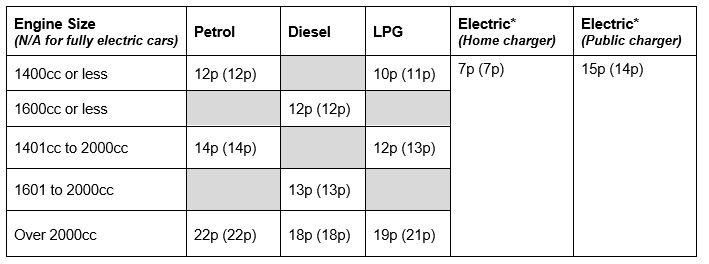
Previous rates are shown in brackets.
*Fully electric cars only. Note that for hybrid cars, you must use the petrol or diesel rate.
You can also continue to use the previous rates until 31 March 2026.
Employees using their own cars
For employees using their own cars for business purposes, the Advisory Mileage Allowance Payment (AMAP) tax-free reimbursement rate continues to be 45p per mile (plus 5p per passenger) for the first 10,000 business miles, reducing to 25p per mile thereafter.
Input VAT
Within the 45p/25p AMAP payments, the amounts in the above table represent the fuel element.
The employer is able to reclaim 20/120 of the fuel amount as input VAT provided the claim is supported by a VAT invoice from the filling station. For a 1300cc petrol-engine car, 2p per mile can be reclaimed as input VAT (12p x 20/120).
Employer Provided Vehicles and Taxable Benefits in Kind
On the topic of company cars, it should be remembered that as we head into a new tax year, the flat-rate figures used in the computation of some employer-provided vehicle benefits-in-kind calculations will be increased for inflation.
From 6 April 2026:
- The flat-rate van benefit charge will be increased from £4,020 to £4,170.
- The flat-rate van fuel benefit charge will be increased from £769 to £798.
- The multiplier for the car fuel benefit charge will be increased from £28,200 to £29,200.
Where an employer provides an employee or a director with a company car, this is usually a taxable benefit-in-kind.
The taxable amount of the benefit depends on the vehicle’s power supply, its manufacturer’s list price and CO2 emissions.
A reduction is given for any periods where the car is unavailable.
Pool cars owned by the employer and used by a number of employees will not normally lead to a taxable benefit-in-kind.
Certain conditions need to be met, including the car only having very low or incidental private use and it being used by different employees, none of whom normally take it home at night.
Overall
Great care needs to be taken with company vehicles and tax.
Indeed, in a recent tax tribunal case, a company director learned this lesson the hard way, after relying on an informal agreement reached with HMRC over 25 years earlier.
In MWL International Ltd and Maywal Ltd v HMRC [2026], the business had treated a number of cars as pool cars and reported no benefit in kind for over two decades.
During a later PAYE audit, HMRC decided the vehicles did not genuinely qualify as pool cars because the conditions had not been properly met.
Significant National Insurance bills then followed.
The company fought back but the Upper Tribunal ruled that HMRC cannot be prevented from applying the correct tax rules, regardless of any past informal agreement.
The case is a stark reminder that a vehicle must genuinely satisfy all of the pool car conditions in practice, not just on paper, and that an informal nod from HMRC, however long ago, offers no lasting protection.
Sourcing Labour from Third Parties? Due Diligence Required!
Just a final reminder for any businesses sourcing workers from third parties (e.g. through agencies or ‘umbrella companies’) that new rules come into effect from 6 April 2026 that may make you jointly and severally liable for the PAYE and NIC costs of those workers, should the third party fail to pay HMRC.
To avoid unexpected tax costs, we strongly recommend that supply chains are reviewed and the new rules are understood.
The content in this blog is correct as at 19th March 2026 See terms and conditions.

